The best glue for rhinestones is Gem-Tac on hand-washed fabric, E6000 Fabri-Fuse on anything that goes in a washing machine, and E6000 or B7000 on hard surfaces like tumblers, cases and shoes. Surface and laundry decide it. Strength alone never does.
That is the entire answer, and almost every project that sheds stones got one of those three wrong — usually by reaching for whatever tube was already in the drawer.
The short version:
- Water-based (Gem-Tac) for fabric you hand wash. Solvent-based (E6000, B7000) for everything rigid or high-stress.
- Cure time is not dry time. Touch-dry at one hour still means 24 hours before the piece moves.
- Hotfix stones don't take glue at all — the grey coating on the back is there to melt, not to bond.
- No adhesive rescues a dot that skinned over before the stone landed.
The Four Adhesives Worth Owning
Four products cover every rhinestone project I have ever done. The differences that matter are base chemistry, cure time and wash rating — not brand loyalty.
| Adhesive | Base | Dry / set | Full cure | Wash rating | Where it wins |
|---|---|---|---|---|---|
| Gem-Tac | Water-based | 1 hour | 24 hours | Hand wash | Cotton, jersey, leather, vinyl, low-odor indoor work |
| E6000 Fabri-Fuse | Fabric-specific | 8 hours flat | 72 hours | Machine washable | Tees, hoodies, anything laundered on a cycle |
| E6000 | Solvent | Sets in ~10 min | 24 h, max at 72 h | Washer/dryer safe | Shoes, leather, metal, hard plastic, high flex |
| B7000 | Solvent | Sets in ~10 min | 24–48 hours | Not published | Tumblers, phone cases, fine precision work |
The wash column is where the real difference sits. Beacon's Gem-Tac product page carries one washability line and it reads "Washable (Hand Wash)" — not machine, not dryer. Everything else about the product is generous (wood, leather, vinyl, pearls, plastic all listed) and that single rating is the constraint people miss.
E6000 sits at the other end. Eclectic Products rates it waterproof, washer/dryer safe, paintable, and good "from -40 to 180 °F (-40 to 82 °C) intermittently" on the E6000 page — the temperature line is what quietly rules out dishwashers, hot cars and anything left on a radiator. Its blind spot is materials rather than conditions: it will not bond polystyrene, polyethylene, polypropylene, Styrofoam or paper, which covers a surprising number of cheap phone cases.
Fabri-Fuse is the sibling built for laundry: dry flat at least 8 hours, "Washable after 72 hours," machine washable, and dry cleaning leaves the bond alone. It is also the only one of the four that advertises stretch and recovery without raising bumps through the fabric, which is why a knit that would slowly defeat a water-based bond stays put.
What Is the Best Glue for Rhinestones on Fabric?
It depends on one question: does the garment go in a machine?
Hand-washed pieces get Gem-Tac. It is the friendliest adhesive on this list — no fumes, cleans up with water while wet, and it was formulated for gems rather than adapted to them. A cotton tee you wash gently, a jacket, a costume piece worn twice: Gem-Tac and nothing else.
Machine-washed pieces get Fabri-Fuse. Beacon rates Gem-Tac for hand washing only, and a regular cycle is exactly the stress that finds that limit. Eight hours flat, 72 before it sees water, and it takes a normal wash after that.
High-abrasion pieces get E6000. Denim that gets sat on, shoes, a bag strap, anything with hardware nearby. It smells, it needs a window open, and it outlasts both of the above.
That is the product decision. The method — cardboard inside the garment, dot size, batch size, fabric-by-fabric behavior — lives in how to apply rhinestones to clothes, which covers heat and needle as well as glue.
Which Rhinestone Glue for Which Surface?
| Surface | Use | Avoid | Why |
|---|---|---|---|
| Cotton, jersey, hand washed | Gem-Tac | Hot glue | Stays flexible, no fumes, dries clear on light fabric |
| Anything machine washed | Fabri-Fuse | Gem-Tac | Only one of the two is rated for a cycle |
| Denim, canvas, heavy wear | E6000 | Water-based | Abrasion beats a water-based bond over months |
| Shoes and Crocs | E6000 | Gem-Tac | Constant flex; foam and rubber need the solvent grip |
| Leather, suede, vinyl | Gem-Tac or E6000 | Heat of any kind | Heat glosses and warps the surface permanently |
| Tumblers, phone cases | B7000 | Super glue | Fine nozzle, and the bond stays slightly rubbery |
| Glass, mirrors, metal | E6000 | Cyanoacrylate | See the next section — super glue and glass disagree |
| Graduation caps | Gem-Tac or E6000 | Hotfix | Stiff board under the polyester, and heat distorts it |
| Sheer fabric, tulle, lace | Nothing — sew | All glue | Any adhesive shadows through thin fabric |
Two surfaces on that list catch people out. Crocs are foam, so a water-based bond peels off the first time the shoe flexes hard. And a graduation cap is fabric over stiff board, which is why the cap guide rules out heat entirely and sticks to glue.
Why Does B7000 Come in Every Bedazzling Kit?
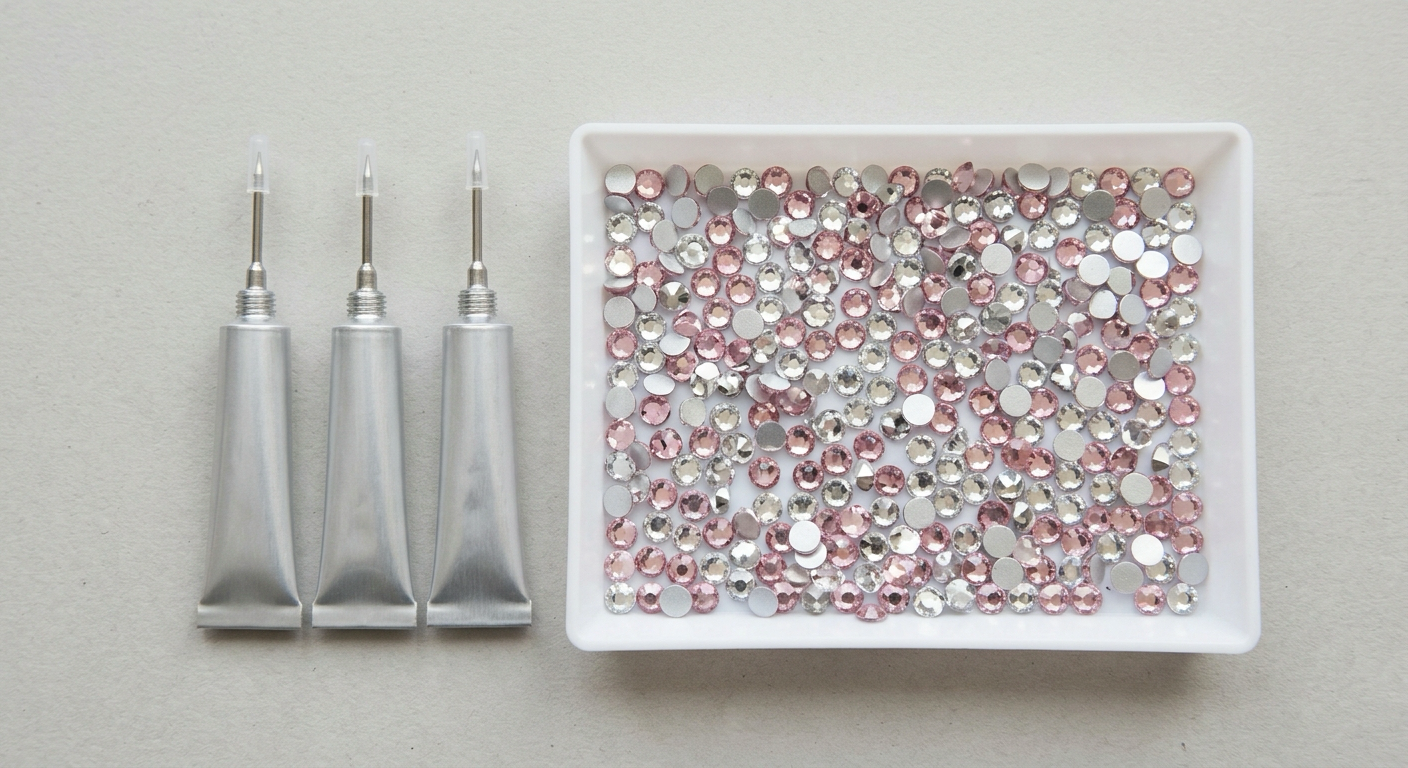
Because it is cheap, it ships with a fine needle tip, and it behaves like E6000 without the brand. If you bought an all-in-one box, the tube inside is almost certainly B7000 — the kit guide covers what else is in there.
Here is the honest part: unlike Gem-Tac, E6000 and Fabri-Fuse, B7000 has no manufacturer specification page I have been able to find in English. There is no published cure time, no wash rating, no materials-to-avoid list. The 24-to-48-hour figure everyone repeats, this site included, is craft-community consensus rather than a stated spec.
That is not a reason to throw it out. It is a reason not to put it on a garment you care about. B7000 on a tumbler or a phone case is fine and precise. B7000 on a shirt that goes through a machine is a guess, and Fabri-Fuse is three dollars away.
Which Glues Should You Never Use on Rhinestones?
Four, and each fails in its own way.
Hot glue. Strong the moment it cools, brittle a week later, and it leaves a raised amber ring you can see from across a room. Any flex in the surface cracks the bond off in whole sections rather than one stone at a time.
Super glue (cyanoacrylate). It cures rigid, and rhinestones sit on surfaces that move. Worse, it fights the stones themselves: Loctite's own listing for Super Glue Ultra Gel Control states it is "Not recommended for use on polyethylene (PE), polypropylene (PP), polytetrafluoroethylene (PTFE), silicone or foam rubber, polystyrene foams, glass, very soft leathers or pure bone china." Glass is on that list, and glass is what a good rhinestone is made of.
School glue and tacky craft glue. They dry to a film with no shear strength and go milky under a faceted stone. Fine for paper, useless under something with weight and edges.
Nail glue. Built for a keratin bond over a two-week life, in a bottle far too small for a few hundred stones. It also yellows in UV.
There is a fifth mistake that is not about the glue at all: buying hotfix stones and then reaching for a tube. Beacon warns against it directly on the Gem-Tac page, and the reason is that the grey coating is built to melt rather than to be wetted by adhesive. Flip a stone over before you open anything. Dull grey patch means heat, clean back means adhesive. The full argument, quote included, is in hotfix vs glue-on rhinestones.
How Much Rhinestone Glue Does a Project Actually Need?
Less than you would guess per stone, and far more than one tube across a big project. Glue tubes are sold by volume and rhinestones by the thousand, so here is the arithmetic that connects the two.
A correct dot is about two-thirds the stone's width. Under an SS12 stone (3.1 mm) that is a dot roughly 2 mm across and 0.4 mm tall — about 1.3 cubic millimetres, or 0.0013 mL of adhesive. So a thousand stones consume around 1.3 mL in theory, and a 2 oz tube holds 59 mL.
Theory is not a shopping list. Squeeze-out, clogged tips, the skin that forms on an open tube and the dot you put down before deciding to move it all cost glue. Real consumption runs three to five times the floor:
| Project | Stones | Glue at the floor | Plan for |
|---|---|---|---|
| Scattered motif on a t-shirt | 300–600 | 0.8 mL | 2–4 mL |
| A phone case back, edge to edge | ~1,040 | 1.4 mL | 4–7 mL |
| A graduation cap, fully covered | ~5,200 | 6.8 mL | 20–34 mL |
| Every stone in a 30,000-piece kit | 30,000 | 39 mL | 120–195 mL |
The last row is the useful one. A 30,000-stone kit needs two to three 2 oz tubes to finish, and it ships with one. Stone counts here use the same 65-stones-per-square-inch figure as the rhinestone calculator — run your own surface through it before ordering either.
Why Stones Still Fall Off With the Right Glue
Buying the right adhesive fixes maybe half of the failures. The rest are technique, and they look identical from the outside.
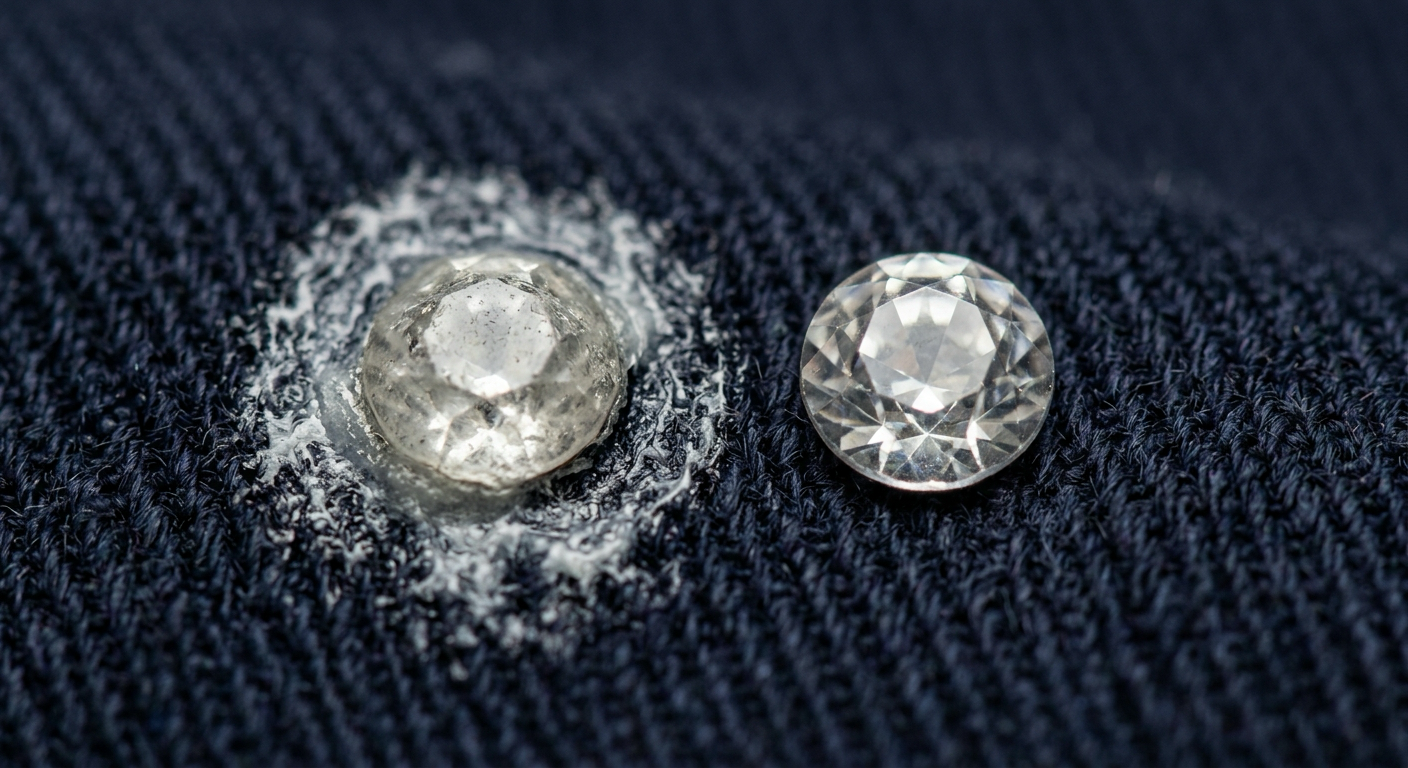
The dot skinned over. Both solvent glues start setting in about ten minutes. Lay forty dots and the first eight are already curing when the stone arrives, so it sits on a skin instead of sinking into wet adhesive. Eight to ten dots at a time, no more. This is the failure that shows up in month two, not week one.
The dot was too wide. A full-width dot squeezes out under pressure and dries as a frosty halo around the stone. Two-thirds, and the pressing does the spreading.
Fabric softener. It leaves a coating adhesive cannot grip. Wash and fully dry the garment first, no softener, no dryer sheet.
It was never cured. Touch-dry is not cured. Gem-Tac is dry at an hour and cured at 24. E6000 hits maximum strength at 72. Moving a piece at hour six is why the stones came off in the car.
The stone was hotfix. No glue on earth fixes that one.
FAQ
Is Gem-Tac or E6000 better for rhinestones?
Neither is better outright — they solve different problems. Gem-Tac is water-based, odorless, formulated for gems, and rated by Beacon for hand washing, which makes it the default for fabric you treat gently. E6000 is solvent-based, waterproof, washer/dryer safe and far stronger on shoes, leather, metal and plastic, at the cost of fumes that need an open window. If the piece goes in a washing machine, skip both arguments and use E6000 Fabri-Fuse.
How long does rhinestone glue take to dry?
Dry and cured are different numbers, and the second one is what matters. Gem-Tac is dry in 1 hour and cured at 24. E6000 gets tacky in about 2 minutes, sets in about 10, cures in 24 hours and reaches maximum strength at 72. Fabri-Fuse needs 8 hours flat and 72 before it can be washed. B7000 is generally treated as 24 to 48 hours. Leave any piece flat and untouched for a full day regardless of which tube you used.
Can you wash clothes with glued rhinestones?
Yes, if the adhesive is rated for it and it has fully cured. Fabri-Fuse is machine washable after 72 hours, and E6000 is washer/dryer safe. Gem-Tac is rated hand wash only, so a machine cycle will shorten its life. Whatever you used, turn the garment inside out, wash cold on gentle, and never tumble dry — heat is harder on the bond than water is.
How do you remove rhinestone glue?
It depends on the base. Beacon states that Gem-Tac comes off with water while wet, and through dry cleaning once dry. Solvent glues like E6000 and B7000 do not dissolve in water; the usual route is acetone or an adhesive remover on a hard surface, which is fine on glass or metal and risky on plastic, painted or dyed surfaces. Test on a hidden patch first — plenty of cases and tumblers lose their finish before they lose the glue.
Picking the best glue for rhinestones takes ten seconds once you frame it right: name the surface, then say out loud whether the piece will ever go in a washing machine. Those two answers pick the tube, and everything after that is dot size and patience.
Keep Reading
- How to Bedazzle: The Beginner's Guide — the seven-step method the glue plugs into
- How to Apply Rhinestones to Clothes — glue, heat and needle compared fabric by fabric
- How to Use a Bedazzling Kit — what the tube in your box actually is
- Rhinestone Calculator — the stone count for your surface, which is half of the glue math above
- 27 Bedazzle Ideas — projects sorted by how forgiving they are