Hotfix rhinestones carry dry heat-activated adhesive on the back and bond in seconds under a wand, an iron or a press. Glue-on flatbacks have bare backs and take the adhesive you choose. Heat wins on cotton and denim in volume. Glue wins on everything heat would ruin — and on everything that is not fabric.
Buy one system per project, never both. They are not interchangeable, and the reason is physical rather than a matter of preference.
Skip to your case:
- Cotton or denim, lots of stones, no printed graphic → hotfix
- Anything rigid: tumblers, cases, caps, shoes → glue-on
- Polyester, sequins, vinyl prints, resin stones → glue-on
- Piece needed tonight → hotfix (glue needs 24 hours it will not give back)
- Not sure yet → glue-on, which forgives more mistakes
How Do You Tell Hotfix and Glue-On Apart?
Flip a stone over.
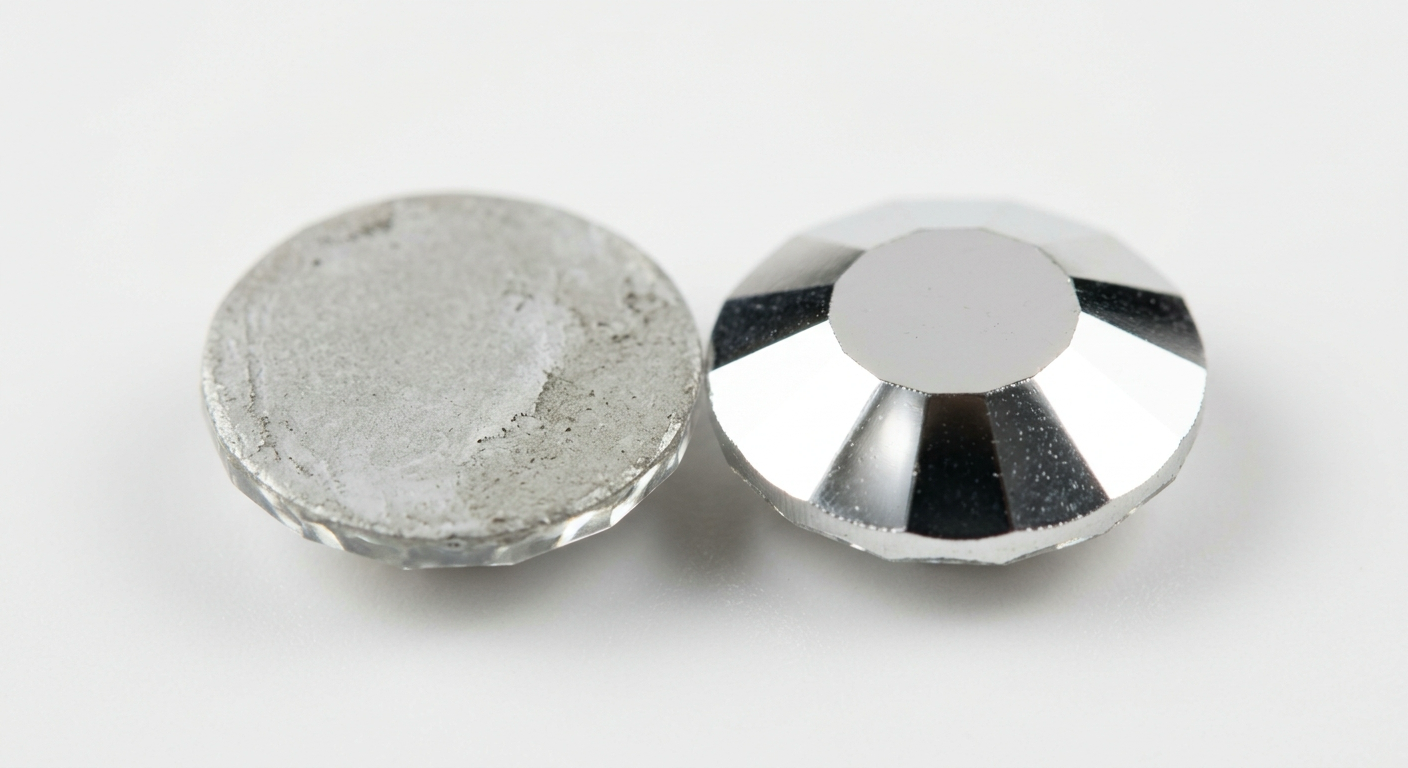
A hotfix stone wears a dull, milky grey patch across its base — dried adhesive waiting for heat. A glue-on flatback has a clean back: bright silver foil on glass, plain moulded surface on resin. No coating, nothing tacky.
That five-second check settles more failed projects than any other habit on this site. Bags get mixed, listings are vague, and "flatback rhinestones" describes both types, so the back of the stone is the only reliable label. If your box came as an all-in-one kit, what's actually in it is almost certainly glue-on.
Hotfix vs Glue-On, Side by Side
| Hotfix | Glue-on flatback | |
|---|---|---|
| What bonds it | Pre-applied adhesive, melted | Any adhesive you choose |
| Tools | Wand, iron or heat press | Bottle with a fine tip, wax pencil |
| Set time | Seconds, plus cooling | 1–72 hours depending on glue |
| Wearable | Same evening | Next day at the earliest |
| Surfaces | Heat-tolerant fabric only | Fabric, plastic, glass, metal, leather, foam |
| Stone materials | Glass and heat-rated only | Glass and resin both fine |
| Repositioning | None — it grabs on contact | A few seconds while the dot is wet |
| Fails by | Scorching, lifting after dryer heat | Skinned dots, wrong glue for the surface |
| Cost per stone | A premium over plain flatbacks | The cheapest stones on the market |
The two rows people underestimate are surfaces and stone materials. Hotfix only exists for fabric — there is no version of it for a tumbler — and it only exists in glass and heat-rated stones, because the resin in a budget kit softens inside the very temperature band the adhesive needs.
When Hotfix Wins, and When It Costs You
Hotfix wins on volume over heat-friendly fabric. A denim jacket back, a dance costume, a team shirt with a big design in a single colour — that is exactly what the system was built for, and there is no cure wait at the end of it.
It also wins on patience. Glue-on demands you work in batches of eight to ten dots and then leave the piece flat for a day. Hotfix has no batch limit, no drying rack, no fumes, and nothing to knock over.
It costs you in three places. The stones themselves carry a premium over plain flatbacks of the same size. The equipment is not optional — an iron works but a wand is far easier for scattered designs. And it removes your margin for error completely: the stone grabs the instant the adhesive melts, so a crooked placement stays crooked.
Glue-on wins everywhere else, which is most of the time. Every hard surface, every heat-sensitive fabric, every resin stone, and every project where you want the option to nudge a stone a millimetre before it commits. Which adhesive to pair with it is a separate decision, worked through surface by surface in the rhinestone glue guide.
Is Hotfix Actually Faster?
Not the way most people apply it, and this is the claim I would push back on hardest.
Stone by stone with a wand, hotfix is slower than glue. A hotfix manufacturer manual puts the heat window at "about 10~35 seconds," adjusted for stone size. Take a small SS10 near the short end at 12 seconds, add roughly 6 more to pick the stone up, position the tip and move on, and you are at 18 seconds a stone — about 200 an hour. Gluing runs 250 to 300 an hour, because the dot and the stone both land in a couple of seconds and the waiting happens later, unattended.
For 1,000 SS10 stones on a cotton tee:
| Route | Active work | Before you can wear it | Extra gear |
|---|---|---|---|
| Glue-on flatbacks | 3.5–4 hours | 24 hours | wax pencil, fine-tip bottle |
| Hotfix, wand, stone by stone | ~5 hours | minutes | applicator wand |
| Hotfix transfer + heat press | ~1 hour to lay the transfer, 20 seconds to press | minutes | heat press |
Those figures come from the documented heat window plus the placing rates used across this site — your hands and your stone sizes will move them, but the ranking holds.
So hotfix does not buy speed at the wand. It buys finish time: the difference between a shirt you can wear tonight and one that has to lie flat until tomorrow. The only route that genuinely collapses the active hours is the third one, and it works by moving the fiddly part somewhere else — you still place every stone, just onto transfer tape instead of the garment.
The Three Ways to Apply Hotfix Rhinestones
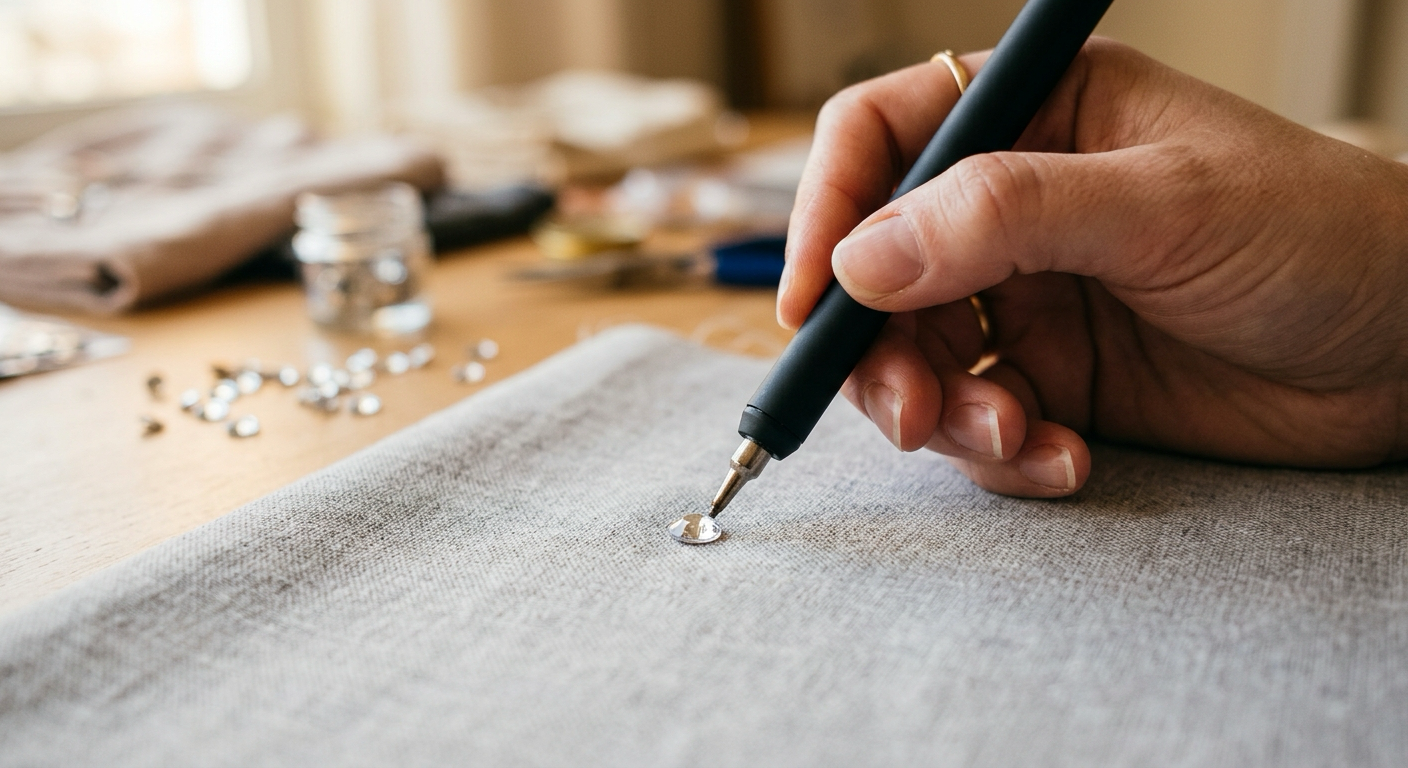
An applicator wand is the default and the one worth owning. Interchangeable tips match stone sizes; you seat the stone in the cup, hold it against the fabric until the adhesive looks wet and glossy, then lift straight up without twisting. Best for scattered designs, lettering and anything you are improvising.
A household iron works and costs nothing extra. The same manual gives 170–180 °C (338–356 °F), or the cotton setting if your iron has no dial, always through a press cloth. Press, do not slide. It is fine for a design laid out on transfer tape, clumsy for placing stones one at a time.
A heat press is the volume answer and the reason commercial rhinestone shirts look uniform. Even pressure across the whole design, every stone at the same temperature for the same time. Overkill for one cap, transformative if you are making twenty.
Whichever route, the instruction that matters most is the one everybody skips: the manual is explicit that you should wait until the stones have cooled before testing whether they stuck. The bond forms as it cools, not on contact. Tug at a stone while it is still warm and you will pull off one that would have held.
Which Fabrics Refuse Hotfix?
Heat is the whole method, so the fabric has to survive it.
Good: cotton, denim, canvas, linen, wool, felt, most untreated polyester at the low end of the range.
Risky: polyester with a sheen, which scorches and glazes; thin knits that mark under a press cloth; anything already stretched out of shape.
No: printed or sublimated graphics, where the heat lifts the print — the classic trap on a game-day jersey, which is polyester and carries heat-applied numbers. Also out: sequins, vinyl, faux leather, waterproof coatings, silk, tulle and lace. And graduation caps, where the stiff board under the fabric warps under an iron.
For any of those, you are on the glue route, and applying rhinestones to clothes covers heat, glue and needle fabric by fabric. On sheer fabric specifically, neither system beats sewing them on.
Test on a hidden seam allowance first. It takes one stone and thirty seconds, and polyester in particular gives you very little warning before it shines.
Can You Glue Hotfix Rhinestones?
You can, and you should expect it to fail.
Beacon states it plainly on the Gem-Tac product page: hot-fix crystals are pre-coated for heat activation and "may not give good adhesion results when used with any glue." That grey coating is engineered to melt into fibres, not to be wetted by an adhesive, so the glue grips the coating rather than the stone and the whole thing peels away as a unit.
The reverse fails just as reliably. An iron does nothing useful to a bare flatback except risk cracking a glass stone or deforming a resin one.
If a bag of hotfix stones turns up and your project cannot take heat, the honest answer is to buy plain flatbacks rather than try to glue them. A second bag of stones costs less than redoing a garment.
FAQ
What are hotfix rhinestones?
Flatback stones with a layer of dry, heat-activated adhesive already applied to the back, visible as a dull grey patch. Heat from a wand, iron or press melts that layer into the fabric, and the bond sets as it cools. They are sold alongside identical-looking glue-on stones, which is why the back of the stone is the only dependable way to tell which you have.
Do hotfix rhinestones stay on in the wash?
Yes, on a suitable fabric and applied properly, but heat is what eventually undoes them. Wash cold, inside out, on gentle, and keep the piece out of the tumble dryer — dryer heat softens the same adhesive the iron melted. Line dry and a hotfix design lasts as long as most glued ones.
Do you need a special tool for hotfix rhinestones?
No, but you will want one. A household iron at the cotton setting with a press cloth works for a design laid out on transfer tape. For placing stones individually an applicator wand is far easier, since the tip holds the stone for you and heats only that spot. A heat press only pays off in volume.
Are hotfix rhinestones better quality than glue-on?
No — the same stone is sold both ways. Quality comes from the material and the cut, not the backing: glass with a foil back throws more light than moulded resin, whatever holds it down. Hotfix does not exist in resin at all, so a hotfix bag is glass by default, which is where the "better" impression comes from.
Between hotfix rhinestones and glue-on flatbacks, the deciding question is never which is stronger. It is what you are decorating and whether it can take heat. Answer that first, buy one system, and the rest of the project stops fighting you.
What to Read After This
- How to Apply Rhinestones to Clothes — the full method for all three routes, fabric by fabric
- Best Glue for Rhinestones — if you landed on glue-on, this picks the tube
- How to Bedazzle: The Beginner's Guide — the seven steps either system plugs into
- Rhinestone Calculator — how many stones the surface takes before you order either type