There are exactly three ways to get a crystal to stay on fabric. Glue it, heat it, or sew it. Everything else is a variation on those three.
Most tutorials pick one and pretend the others don't exist. That's why so many people end up with a hoodie shedding stones after one wash. The method has to match the fabric and the garment's job. A costume worn twice and a jersey worn every Sunday are not the same project.
So this is the full reference on how to apply rhinestones to clothes: the three methods side by side, the real numbers, and how to choose. If you're brand new to all of this, start with my complete bedazzling walkthrough and come back here when you need the technical detail.
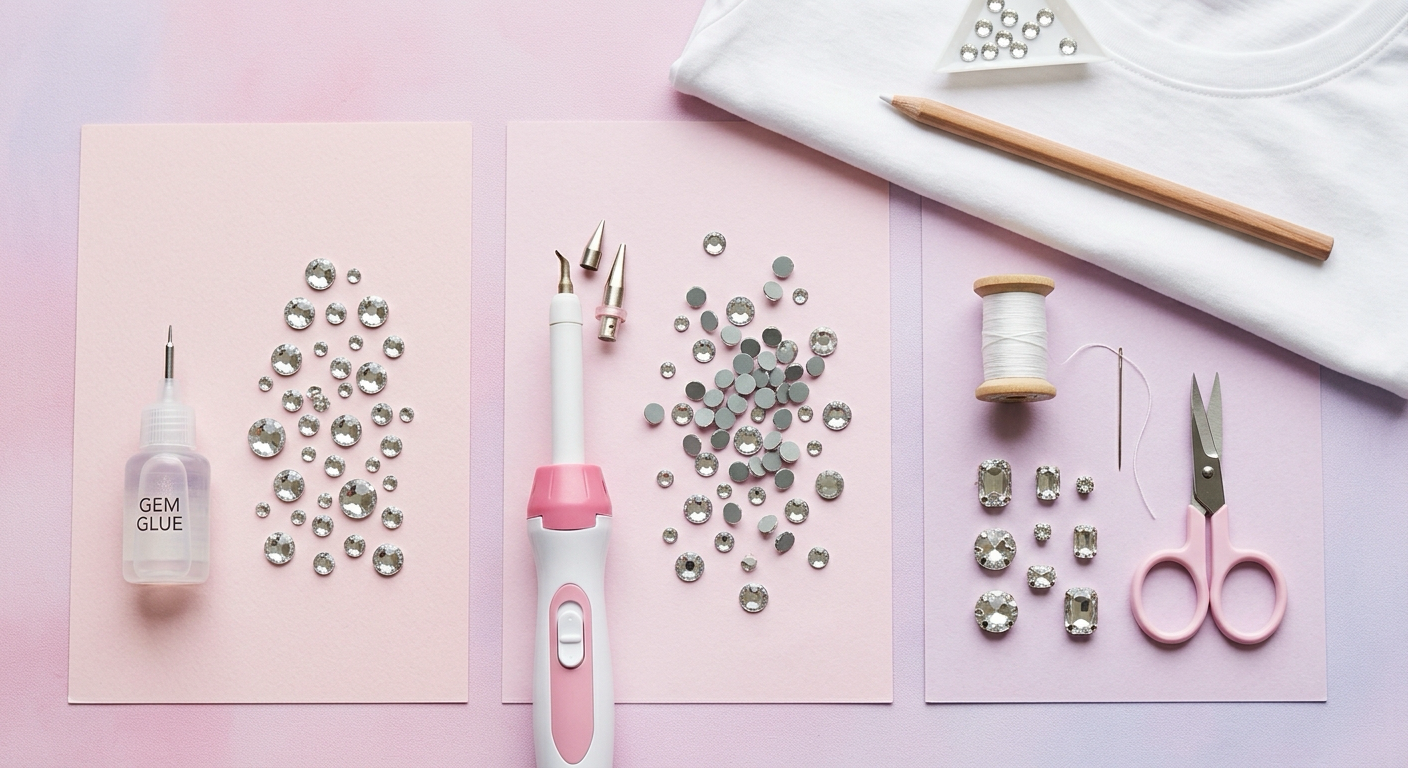
The 3 Methods at a Glance
| Method | Stone to buy | Difficulty | Best fabrics | Ready to wear | Durability |
|---|---|---|---|---|---|
| Glue-on flatbacks | Flatback (clean back, no coating) | Easy, but messy at first | Cotton, denim, canvas, knits, leather, vinyl | 1 h tack, 24–72 h full cure | Strong — survives regular washing with care |
| Hotfix / iron-on | Hotfix (glue-backed) | Easiest, fastest | Cotton, denim, linen, wool, most non-printed polyester | Instant, once cool | Good — as long as it never meets dryer heat |
| Sew-on stones | Sew-on (holes or metal settings) | Slowest, needs patience | Anything, including sheer and heavy wovens | Instant | Strongest — mechanical hold, nothing to re-melt |
Quick read: hotfix for speed, glue for versatility, sewing for anything that has to survive years. Note that rhinestones for clothes are sold by method — hotfix, flatback or sew-on — and they don't swap. Check the packaging before you check out.
Method 1: Glue-On Flatback Rhinestones
Flatbacks are plain crystals with a flat, unglued base. You supply the adhesive. This is the most flexible method because you control the bond, and it's the go-to for stones too big or too fancy for a heat tip.
Two adhesives dominate, and they solve different problems.
Gem-Tac is the fabric-first choice. Beacon's official Gem-Tac product page lists it as water-based, drying clear, "flexible, never brittle," with a 1-hour dry time and hand-wash washability. It bonds fabric, rhinestones, pearls, leather and vinyl. Crucially, Beacon also states it works best with flatback crystals, not hotfix ones — hotfix stones are already coated for heat activation, and that coating gets in the way of glue.
E6000 is the strength choice. Eclectic Products' official E6000 page describes it as washer/dryer safe, drying to a rubber-like consistency that flexes with the material, and rates it at "30X more flex than polyurethane." Working times are specific: tacky in about 2 minutes, setting in about 10, fully cured in 24 to 72 hours. It bonds nearly everything except polystyrene, polyethylene, polypropylene, Styrofoam and paper. B7000 sits in the same solvent-based family and usually ships with a fine needle nozzle, which makes it popular for tiny precision work.
My rule: soft, drapey, gently-washed garments get Gem-Tac (Beacon rates it hand-wash, so machine-washed pieces get E6000 Fabri-Fuse, its fabric-specific sibling — dry flat 8 hours, washer-safe after 72). Structured, high-abrasion, heavy pieces get E6000 or B7000.
Step 1: Prep the fabric
Wash and fully dry the garment first, with zero fabric softener. Softener leaves a coating that adhesive hates. Slide a piece of cardboard or a plastic sheet inside the garment so glue can't bleed through to the back layer. Press out every wrinkle.
Step 2: Mark your design
Use a water-soluble fabric pen or chalk. Dots, not outlines — an outline gets covered by the stone, but a leftover line peeking out from under a crystal is forever. If you're mixing stone sizes, sketch the big ones first and let the small ones fill the gaps.
Step 3: Glue in small batches
Lay 8 to 10 dots at a time, no more. Both glues skin over faster than you expect, and a dot that has started curing gives you a stone that pops off in month two.
Step 4: Place, press, cure
Pick up each stone with a wax pencil, set it straight down onto its dot, and press gently for 2 to 3 seconds. Let the piece cure flat and undisturbed. Gem-Tac wants an hour to set and 24 to cure. E6000 wants 24 to 72 hours before anything resembling stress.
Method 2: Hotfix (Iron-On) Rhinestones
Hotfix stones come with a dot of dry heat-activated glue already on the back. You melt it, it soaks into the fibers, it sets as it cools. No bottle, no drying rack, no mess. This is why hotfix is the fastest route for anyone attaching rhinestones to fabric in volume. Torn between the two systems? The hotfix vs glue-on comparison goes deeper on the trade-offs.
The numbers matter more here than in any other method. A hotfix manufacturer instruction manual specifies an ironing temperature of roughly 170 to 180°C (338 to 356°F) and a press time of 10 to 35 seconds depending on stone size — smaller stones need less. Too cool or too quick and the stones peel off. Too hot or too long and the glue seeps out around the edges and dulls the crystal. If your iron has no temperature dial, that manual points you at the cotton setting.
Step 1: Choose your tool
An applicator wand heats one stone at a time and gives you total placement control. A household iron does whole sections at once but needs a Teflon sheet or a thin cotton press cloth between the iron plate and the stones — never touch crystals directly with the plate.
Step 2: Heat up properly
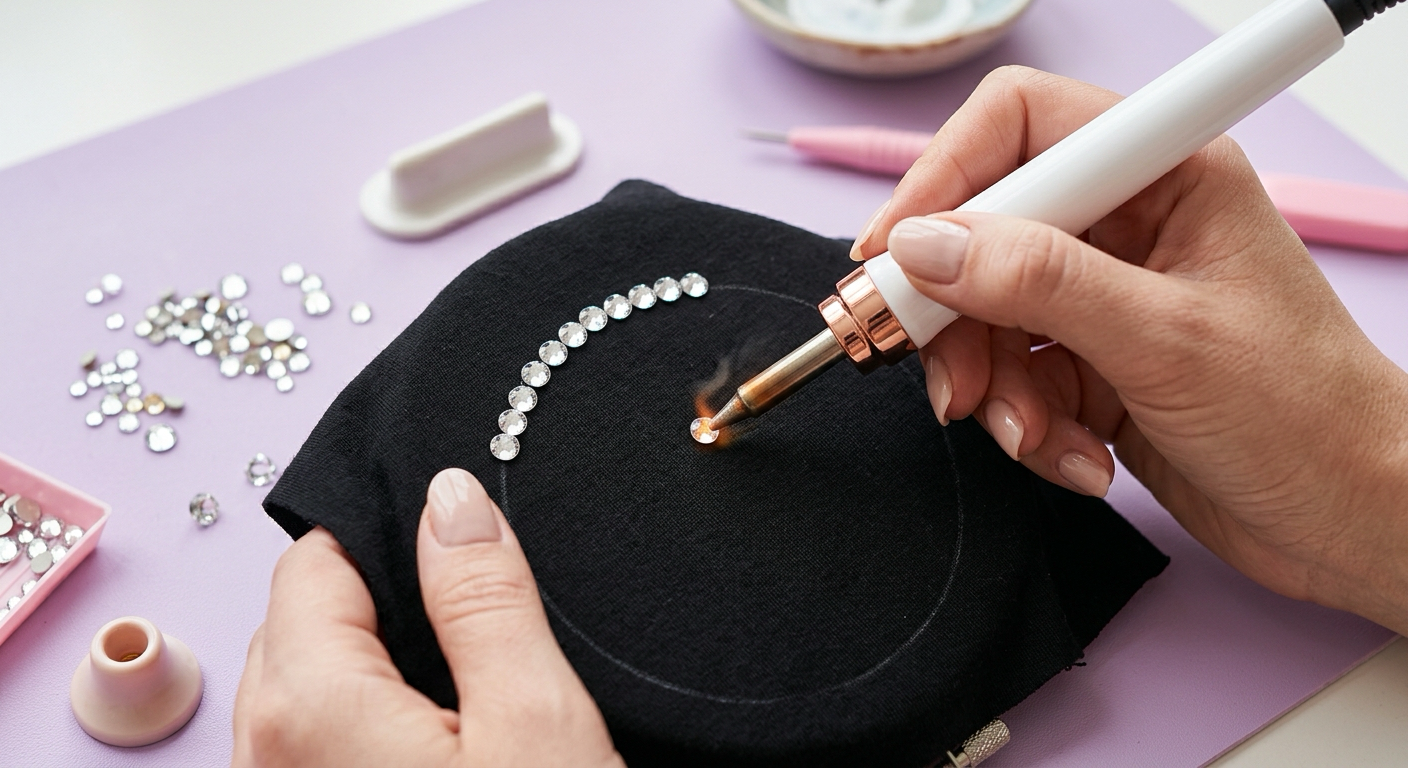
Screw the correct metal tip onto the wand before powering it on, then give it a full 5 minutes to reach temperature. Cosplay Supplies' applicator tutorial makes the same point and adds a useful sanity check on materials: fabrics that absorb water — cotton, linen, wool — take hotfix well, while leather, glass and metal will pop stones off at the slightest movement. (Silk and suede technically absorb too, but heat marks them — see the fabric guide below before trying.)
Step 3: Pick up and activate
Touch the tip to the top of the stone; it should lift and sit centered in the cup. Hold until the glue looks wet and shiny — within the same 10 to 35 second window, small stones at the short end. A whisper of smoke or bubbling at the base means it's ready.
Step 4: Set and cool
Bring the wand straight down, press without twisting, then lift straight up. Wiggling smears the melted glue into a visible halo. Then leave it alone. Let every stone cool completely — a good 30 seconds — before you tug on anything. The bond forms on cooling, not on contact.
Method 3: Sew-On Stones
Sew-on stones are the method everyone forgets and the one that outlasts both others. The stone either has two small holes drilled through it or sits in a metal setting with sewing loops. No adhesive anywhere — the hold is mechanical, which is why a sewn stone survives years of washing that would eventually beat any glue. Budget about a minute a stone once you find the rhythm; nobody sews 3,000 of these, and nobody needs to.
Step 1: Pick your stones and thread
Sew-on stones only — check the listing, because flatbacks and hotfix have no holes. You'll need a fine needle that fits through the holes and polyester thread in a matching color. Polyester over cotton: it stretches slightly and doesn't rot.
Step 2: Anchor the thread
Knot on the back, come up through the fabric at the stone's position, and take one tiny stay-stitch before the stone goes on. That anchor stops the whole run loosening if one loop ever wears through.
Step 3: Stitch through, not around
For drilled stones, come up through one hole, down through the other, three to four passes per hole. For metal settings, loop through each sewing ring the same way. Keep the tension snug but not puckering — sheer fabric especially will gather if you pull hard.
Step 4: Knot off every few stones
Don't run one continuous thread across a whole design. Knot off every three to five stones so a single broken thread costs you a small cluster, not the full row. On sheer fabric, tie off behind each stone.
Chiffon, organza, lace: on anything glue would shadow through, sewing beats sticking every time.
Which Method Works on Which Fabric?
The real answer to how to apply rhinestones to clothes is not a method, it's a match. Here's how I decide.
Cotton and cotton blends. The friendliest surface there is. All three methods work. Hotfix is my volume shortcut on cotton — fast, and the fibers take heat easily — but for a first project or a single motif, flatbacks and glue are more forgiving. Detail on placement and neckline logic lives in my rhinestone shirt tutorial.
Polyester and performance fabrics. Polyester scorches, shines and can literally melt in the temperature range hotfix needs. It's doable, but you press at the low end — 170°C / 338°F — with a press cloth, and you test on a hidden seam allowance first. Anything with a printed or sublimated graphic is worse — heat can lift the print. This is exactly the trap in bedazzling a game-day jersey, where the fabric is polyester and the numbers are heat-applied vinyl. On a printed jersey, glue-on is the safer call.
Denim and canvas. Thick, stable, abrasion-heavy. Hotfix bonds well into denim and it's the one fabric where heat is genuinely faster than glue for big designs. But for jeans that get sat on and washed weekly, E6000 or B7000 outlast it — pick by how hard the piece will live.
Fleece and sweatshirt knits. The classic hoodie case. The brushed surface is lofty, so stones need a beat more pressure for full contact, SS16 and up bridge the pile better than small stones, and glue is the safer call than hotfix on deep fleece.
Stretchy knits, spandex, jersey knit. The bond has to stretch or it snaps. Gem-Tac and E6000 both stay flexible when cured, which is why they beat rigid super-glue-type adhesives here. Smooth the fabric flat at its natural resting size — never stretched — while you work, and never stone across a seam that has to move.
Delicates: silk, chiffon, tulle, lace. Sew-on, almost always. Glue bleeds through and leaves a dark shadow ring on thin fabric. Heat marks silk. Sew-on stones in metal settings hang correctly on sheer fabric and don't stiffen the drape.
Leather, suede, vinyl and faux leather. Glue only — heat warps, glosses or marks the surface. Gem-Tac explicitly lists leather and vinyl and is fine for low-stress pieces like bags; for shoes, go E6000 or B7000, because flexing footwear tears water-based bonds.
How to Put Rhinestones on Clothes Without a Glue Mess
The technique gap between a clean result and a cloudy one is almost entirely about how much glue leaves the bottle.
Dot size: about two-thirds the diameter of the stone. Not the full width. The stone squashes the dot outward as you press, and a two-thirds dot spreads to exactly the edge. A full-width dot spreads past the edge and dries as a visible frosty ring that catches lint forever.
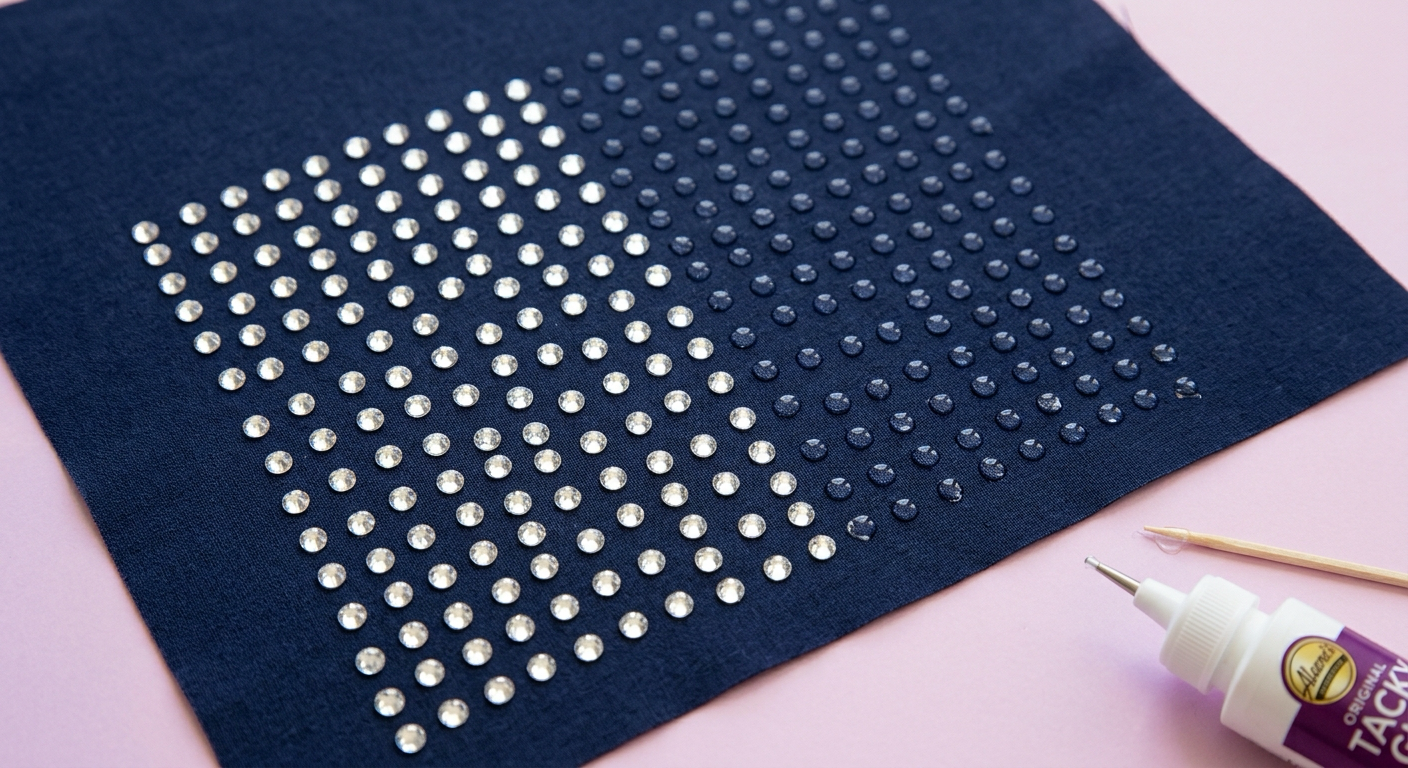
Toothpick vs. syringe. A toothpick is free and fine for stones SS16 and up, where the dot is big enough to control. Below SS10 you want a syringe or a precision needle tip — a toothpick dot is simply larger than the stone. Pull the applicator straight up and away to break the string of glue instead of dragging it sideways. If you're unsure which stone size you're working with, the SS size chart sorts it out fast.
Wax pencil pickup. Press the wax tip onto the top facet, lift, position, then press the stone down onto the glue and roll the pencil off sideways. The glue grabs harder than the wax, every time. Tweezers work too but they flip stones face-down constantly.
Pressing without smearing. Straight down, 2 to 3 seconds, straight up. Zero rotation. If glue does escape, do not wipe it wet — you'll spread a thin film that dries cloudy over a wide area. Let it fully cure, then pick the hardened bead off with a pin.
Work in rows, not randomly. Complete one row, let it set, start the next. Random placement means your hand and sleeve keep landing in wet glue.
Before you buy anything, run the numbers through the rhinestone quantity calculator so you're not 300 stones short halfway through a sleeve.
Aftercare and Washing
The application is only half the durability story — and care splits by method.
- Glue: wait for a full cure before the first wash. Gem-Tac dries in 1 hour but cures in 24; E6000 needs 24 to 72 hours. Give any glued garment 72 hours before it sees water.
- Wash inside out, cold, gentle, in a mesh bag. The stones ride against fabric instead of the drum, and a mesh bag costs a couple of dollars.
- Hotfix: the dryer is the killer. Tumble heat re-softens the factory glue. Air dry flat, always.
- Sew-on: check the threads, not the bond. No adhesive to fail — give the stitching a look every few months and re-knot anything fuzzy.
- No fabric softener, no bleach. Softener creeps under stone edges and weakens the bond over time.
- Never iron over stones to press wrinkles later. Press around the design or iron the back — the press cloth trick is for application, not for laundry day.
- Keep spares. Set aside about 20 leftover stones per project in a labeled bag. Replacing one stone in year two takes ninety seconds; matching a discontinued color does not.
6 Common Mistakes
- Using glue on hotfix stones. Beacon says it plainly on the Gem-Tac page: hotfix crystals are pre-coated for heat activation, and that coating blocks proper adhesion. Buy flatbacks for gluing.
- Too much glue. The cloudy halo around every stone is the #1 giveaway of a beginner project. Two-thirds dot. Always.
- Ironing directly on hotfix crystals. The plate scratches the facets and can crack the coating. Teflon sheet or press cloth, no exceptions.
- Sewing with cotton thread. It rots and snaps years before polyester does. Polyester thread, always, and knot off every few stones.
- Using a steam iron on hotfix. Steam vents heat unevenly and moisture fights the melting glue. Dry iron, solid plate zone, or a wand.
- Ignoring the fabric. Hotfix on printed polyester, glue on chiffon, heat on leather. Match the method to the material before you touch a single stone.
The short version: hotfix on plain cotton and denim when you're working in volume, glue on leather and on anything you're stoning for the first time, a needle on anything sheer. Then cure fully, wash cold, never tumble dry.
FAQ
What is the best way to attach rhinestones to fabric?
There isn't one winner — there's a best answer per garment. For everyday cotton clothing you'll wash constantly, hotfix is fast and holds well. For denim, leather, vinyl, or anything getting real abrasion, a flexible glue like E6000 or B7000 wins because it stays rubbery and moves with the material. For sheer or expensive fabric, or a piece that needs to last for years of hard wear, sew-on stones are mechanically anchored and objectively the strongest. Decide by fabric first, then by how often the piece gets worn.
What glue works best for rhinestones on clothes?
Gem-Tac for soft, drapey, hand-washed fabric; E6000 Fabri-Fuse for machine-washed clothing; E6000 or B7000 for structured, high-abrasion pieces like denim, shoes and bags. All cure flexible, which is what fabric needs. Working times: Gem-Tac sets in 1 hour and cures in 24; E6000 is tacky in 2 minutes and at full strength inside 72 hours. Glue only works on flatback stones — hotfix backing actively blocks it.
Do hotfix rhinestones stay on after washing?
Yes, when they're applied at the right temperature for the right duration and then washed carefully. The manufacturer range of roughly 338 to 356°F with 10 to 35 seconds of press time exists because under-heating is the main cause of stones falling off. Once properly set, wash the garment inside out on cold, on a gentle cycle, and air dry. Heat from a tumble dryer is what kills hotfix designs — the same glue that melted to attach the stone will soften again in a hot drum.
Can you iron on regular rhinestones?
No. Regular flatback rhinestones have nothing on the back but flat foil or plain glass — there is no adhesive to melt, so an iron does nothing except risk cracking the stone. Only hotfix rhinestones are iron-on, because they're manufactured with a dry heat-activated glue dot already bonded to the base. That backing is usually visible as a slightly cloudy grey or milky layer on the underside. If the back is shiny and clean, it's a flatback and it needs glue.
What fabric is hardest to rhinestone?
Sheer fabrics like chiffon, organza and fine tulle. Glue soaks through and shows as a dark ring from the front, and there's not enough fiber for hotfix adhesive to grip. Sew-on stones with metal settings are the real answer there. Runner-up difficulty goes to heavily textured knits like chunky cable sweaters and terry cloth, where the surface is too uneven for a flat stone base to make contact — and to printed or sublimated polyester, where the temperature window that activates hotfix glue overlaps with the temperature that ruins the print.
Related Guides
- How to Bedazzle: The Complete Beginner's Guide — the full pillar walkthrough, start to finish
- How to Bedazzle a Shirt — placement, design layout and washing for tees
- Hotfix vs Glue-On Rhinestones — the two systems head to head
- Sew-On vs Iron-On Rhinestones — when the needle beats the wand
- Rhinestone Quantity Calculator — how many stones your design actually needs